
Mark Mamlouk, MD, Gives Back to Where It All Began
When Mark Mamlouk, MD, walks into UCSF as a volunteer, he’s not just stepping into a familiar hospital; he’s returning to a place that helped shape his career. For over a decade, he has donated his time as a neuroradiologist, educator, and mentor, building connections that span generations of trainees and touching lives well beyond the reading room.
Dr. Mamlouk’s relationship with UCSF stretches back to his own training. After completing his fellowship, he began volunteering while working at Kaiser Permanente, drawn by a desire to remain connected to UCSF community. “I really enjoy working in this role as a volunteer,” he shares. “It’s something I like to give back as an alumnus.”
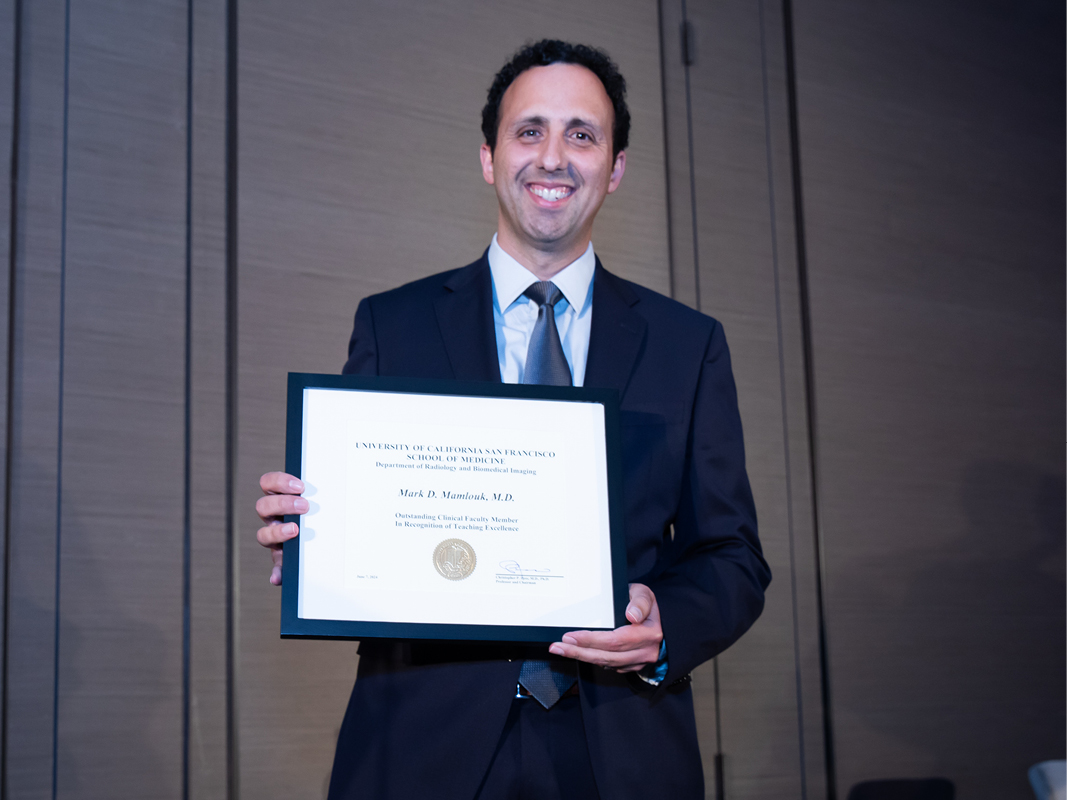
His volunteer days are packed with activity, from reading cases alongside trainees to giving didactic lectures to performing interventional procedures. “It’s a well-rounded experience of boots-on-the-ground radiology work, but also didactics and procedures,” he explains. He’s especially attuned to how his role differs from that of full-time faculty. “I am more of a friend or a confidant,” he says. “Sometimes the trainees open up to me and are a bit more candid with me, and I can be a bit more candid with them.”
Teaching is a central theme in Dr. Mamlouk’s volunteer work. He emphasizes efficiency, search patterns, and clear reporting, all skills that are critical in radiology. But his contributions are not one-sided. “Every time I go, I learn a lot from them the trainees,” he notes. Whether it’s staying current with new imaging technology or reinforcing his own understanding through teaching, the learning is mutual.
One particularly memorable experience involved identifying a misdiagnosed condition during a teaching session. He and a trainee discovered a cerebrospinal fluid (CSF) leak in a patient who had been referred for brain surgery. “We were able to suggest that, perform a CT myelogram and prove it, and eventually treat it,” he recalls. “It was very touching. We were able to make a difference.” That moment, he says, was meaningful not just for the patient, but also for the trainee, who saw firsthand the real-world impact of careful diagnostic work.
Volunteering has also helped him maintain connections across the medical community. “It’s permitted lifelong friendships between me and some of the trainees and other faculty,” he reflects. “Being able to volunteer and still be around legendary faculty… some of these moments you never forget.”
For clinicians considering volunteer work, Dr. Mamlouk believes the benefits are substantial. “You’re able to reap a lot of the benefits of academia—education, research, and networking,” he says. “Even if you’re not in a traditional academic job, you can still be part of that environment.”
When asked to describe himself as a radiologist, Dr. Mamlouk pauses thoughtfully before offering, “Detective, communicator, and unknown supporter.” The last term reflects the often invisible, yet vital role radiologists play. “You find someone with a devastating condition and their condition improves, you feel very happy, and you’re supporting that patient, even if they don’t know who you are.”
As UCSF celebrates National Volunteer Week, Dr. Mamlouk’s story serves as a reminder of how volunteerism can strengthen academic medicine and community alike—one case, one trainee, and one meaningful connection at a time.