
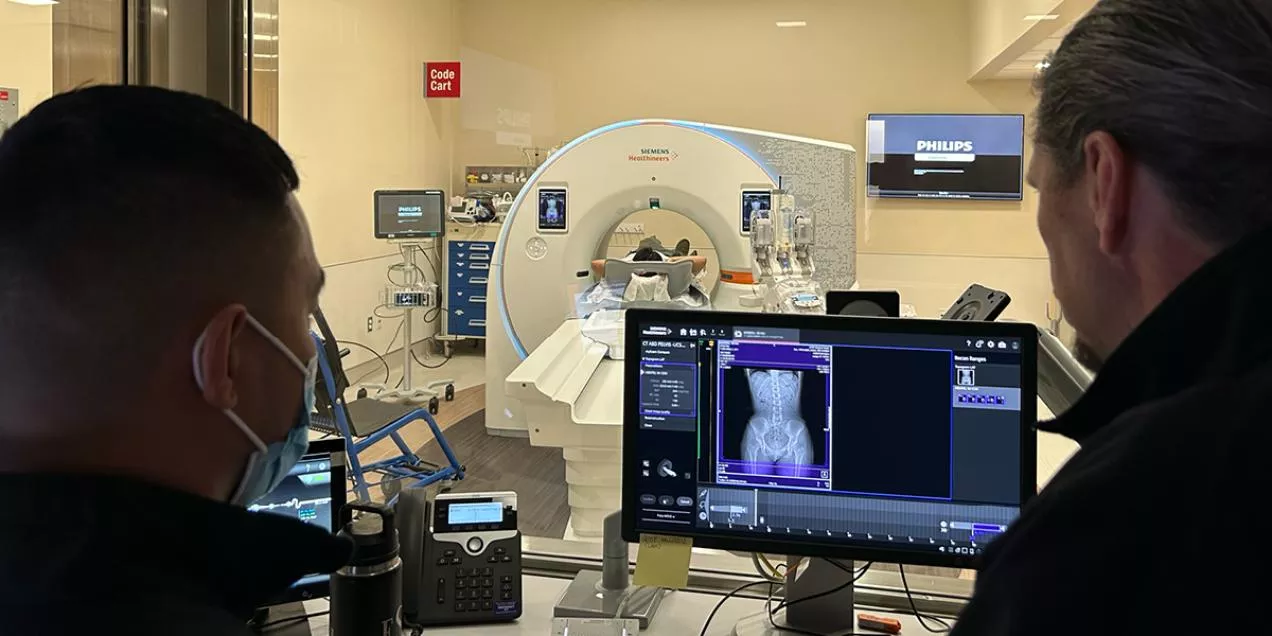
On October 17, UCSF completed the first clinical patient scans using the new photon-counting CT (PCCT) in the Parnassus Emergency Department (ED). Alastair Martin, PhD, vice chair for capital projects, notes that “This significant investment in cutting-edge technology offers expanded functionality and improved image quality in UCSF’s high-demand, high throughput ED.”
Because it is so versatile, PCCT can reduce the need for additional imaging and minimize delays in patient care, allow radiologists to visualize small structures in very fine detail, and provide information about the composition of structures in the body. Together, these capabilities support timely decision-making in the ED setting, where rapid assessment and intervention are often critical.
“With photon-counting CT, our emergency patients will benefit from faster scans and significantly lower radiation doses compared to conventional CT,” said Christopher Hess, MD, PhD, chair of the Department of Radiology & Biomedical Imaging. “This new technology provides UCSF radiologists with a powerful new tool to identify subtle fractures, detect complex vascular, cardiac, and respiratory conditions, and characterize early-stage disease. In some cases, photon-counting CT can even be used when MRI is not readily available, particularly when rapid diagnosis is essential.”

More PCCTs to come
UCSF chose Siemens and their industry-leading Naeotom Alpha photon-counting CT platform. Javier Villanueva-Meyer, MD, vice chair, clinical quality and technology, notes that “This photon-counting CT represents more than a technological upgrade. It's the first milestone in a series of strategic equipment installations that will ensure our patients continue to receive the world-class, cutting-edge care our institution is known for."
Over the next five years, UCSF plans to install a minimum of six new PCCT systems, split evenly between inpatient and outpatient sites, on this general timeline –
- 2027: one PCCT at Parnassus hospital for inpatients and one PCCT at China Basin for outpatients.
- 2028: two PCCTs for outpatients, with the location(s) to be determined.
- 2030: two PCCTs for inpatients at the new Parnassus hospital.
Patient experience with photon-counting CT
Kimberly Kallianos, MD, modality director for CT, said that “We look forward to enhanced spatial resolution, robust spectral data, and new workflow optimization tools for radiologists. For patients, the large scanner bore is more comfortable. The scanner bed is positioned quickly and optimally with a camera which results in high quality imaging at a lower radiation dose. A tablet embedded in the scanner allows technologists to do some protocol tasks directly at the bedside, for more time at the patient’s side.”
How photon-counting CT works
Computed tomography (CT) transmits X-rays through tissues at various angles. These data are processed by computer algorithms to generate detailed 3D images of anatomical structures.
In standard energy integrating CT detector technology, X-ray photons are first converted to light before being transformed into an electrical signal. This two-step process can result in loss of information and lower quality images.
Photon-counting CT (PCCT) directly converts each X-ray photon into an electrical signal, measuring individual photon energy with high precision. By analyzing the energy of each photon, PCCT can produce images with enhanced spatial resolution, reduced noise, and improved tissue contrast. PCCT also allows spectral analysis which provides information about the composition of tissues.
PCCT allows radiologists to analyze, with greater accuracy, small, complex structures such as the anatomy of the inner ear, blood vessel walls, or tiny tumors. PCCT also reduces imaging artifacts and enables differentiation of tissue types, all with lower radiation doses than standard CT systems.
Investing in patient care
UCSF Health and the Department of Radiology and Biomedical Imaging are pleased to partner on these investments in advanced imaging technology to provide faster, safer, more accurate diagnostic imaging for patients.