
High Speed Chemistry: Joseph Blecha, MS
 To Joseph Blecha, MS, radiochemistry has the right mixture of diligence, problem solving, and time sensitivity, with just a touch of madness. During his 18 years at UCSF, he has helped improve the imaging and treatment of Alzheimer’s, ALS, prostate cancer, and many other diseases. Describing his radiochemistry work, he joked, “Sometimes this job feels like the definition of insanity. If something doesn’t work, the very first thing is to do the exact same thing and expect a different result.”
Much of Blecha’s work at China Basin centers on synthetizing radio-labeled small molecules and antibodies which allow researchers to visualize diseases with positron emission tomography (PET) or single photon emission computed tomography (SPECT). As Blecha explains it, PET and SPECT imaging can show the function of organs or tissues and these nuclear medicine techniques may be combined with CT or MRI for improved diagnosis and treatment monitoring of various conditions.
Blecha enjoys the atmosphere of problem solving and tangible feedback that he finds in a chemistry lab. He said, “Thought experiments are fun, but it’s not the same as actually getting an answer.”
While attending San Francisco State on a Department of Defense science scholarship, Blecha planned to attend medical school following the career example of his certified nurse mother. It was during his first organic chemistry exam, as he watched all his pre-med classmates' frustration, that he realized chemistry just made sense to him.
That professor, Clifford Berkman, PhD, proved to be a great mentor. Blecha worked in Berkman’s research lab throughout his bachelor’s and master’s degrees in organic chemistry. Blecha then pursued a PhD at University of Montana with Berkman’s former PI, Chuck Thompson, PhD, who was working on organophosphate chemistries with John Gerdes, PhD. However, once Blecha was in Montana, the prospect of long winters and the long timeline of PhD coursework and grant writing seemed too interminable. Fortunately, Gerdes introduced Blecha to Henry VanBrocklin, PhD, back in California, and catalyzed Blecha’s transition from organic to radiochemistry.
This was not as big a jump as one might imagine, as Blecha tells it, “It’s the same field, just with different constraints. We do fast-forward chemistry.”
Blecha now works with UCSF’s cyclotron group at China Basin, where they produce isotopes such as C-11, F-18, and Ga-68. On-site production is very important for compounds with especially short half-lives, such as O-15 which has a two-minute half-life.
Once a prolific baseball player, Blecha observes that similar superstitions attend radiochemistry, especially when managing variable results under time pressure. “A compound might have only a two-minute half-life. If you stop, it’s gone. So you get specific plastic bottles that you believe in. We have bobble heads that no one dares remove. It might not be rational, but in this micro world of bases and acids, sometimes things just don’t line up.”
But the bobble head illusion has its limits. Collaborators might need new versions of a drug to fit within a very specific mass, which requires adjusting the process to add more radiation while reducing the mass. And the hard work yields results. After fifteen years of working with compounds used in Alzheimer’s imaging, Blecha and his teammates recently published a paper showing the human dosimetry data of the compound (F-18 RP115) for use in PET/MRI. Using this data, they hope to image both Alzheimer’s disease and frontal temporal dementia using F-18 RP115.
Blecha continues to collaborate with former colleagues. Through the VanBrocklin Lab he worked with Berkman’s prostate cancer imaging company on new compound development. With Thompson, Blecha has continued to image organophosphate poisoning and with Gerdes and the Royal Brisbane and Women’s Hospital in Queensland, Australia, Blecha works on the pharmaceutical RP115, a compound for which UCSF holds the patent.
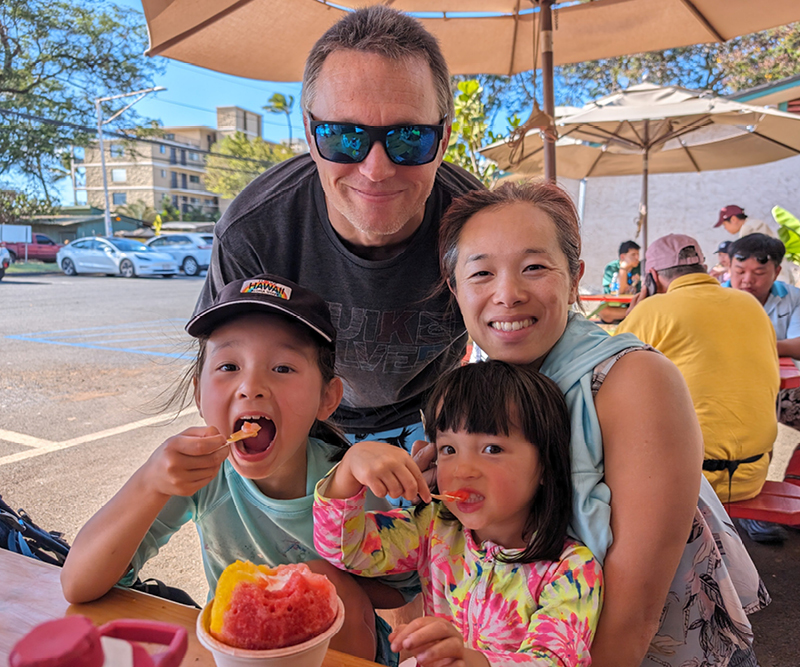 Today, Blecha lives in the Sunset neighborhood of San Francisco with his wife Vivian and two young daughters. His baseball days might be over, but he’s been a bowling league member for 25 years, and he met his wife playing volleyball. They shared the experience of being the shortest people on their teams. On the average weekday, he commutes to China Basin riding his electric bike over the hills. He finds this exercise far more relaxing than sitting still on transit.
Just like in that first organic chemistry exam, Blecha finds peace in these challenges. “The work can be stressful, and sometimes you can’t do what you want even if you perform everything correctly. Years ago, I would have been frustrated with that. But today I have learned that we can make that work. This field teaches you. It pushes you to learn or quit.”