
Xiaoxi Liu, PhD: Postdoctoral Scholar in Image Acquisition
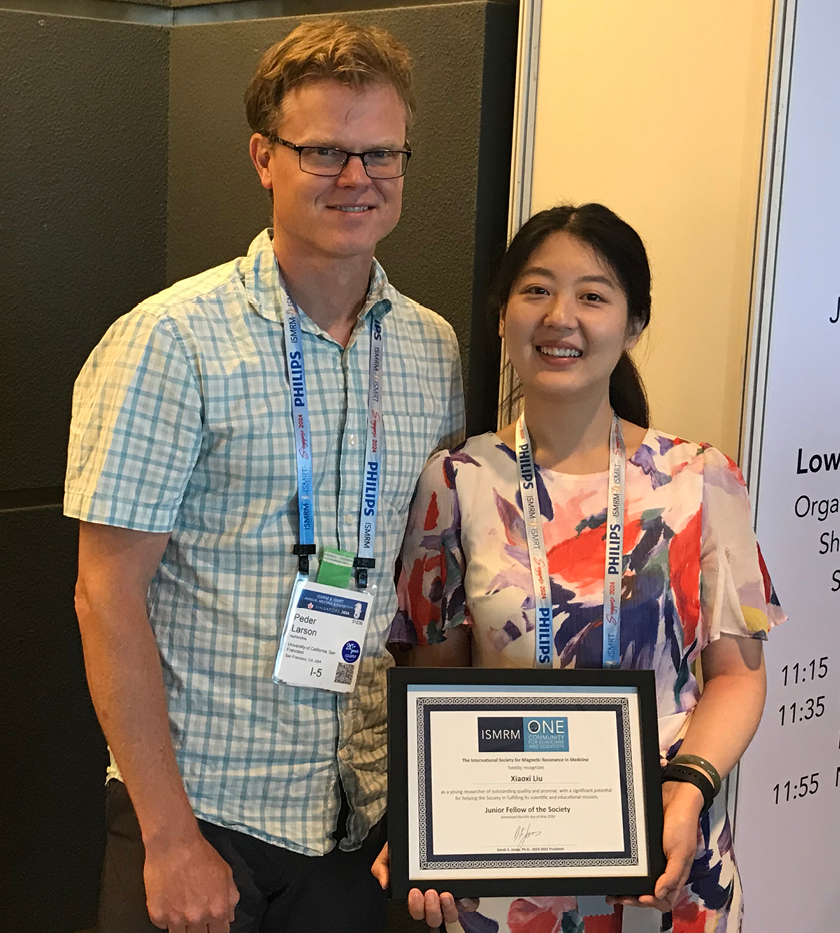
Xiaoxi Liu, PhD, is a postdoctoral scholar and a puzzle solver at heart. Trained in diagnostic radiology at the University of Hong Kong where she worked with Dr. Hing-Chiu Chang, Liu has expertise in sequence design using the Philips pulse programming environment and advanced imaging reconstruction in diffusion imaging. In the Larson Lab, she develops novel pulse sequences and imaging reconstruction methods for renal tumor imaging with hyperpolarized carbon-13 MRI.
As Liu succinctly puts it, "I'm always curious and I want to be useful." A lifelong affinity for mathematics and physics initially drew her to these fields. Yet as she continued her education, she eventually found pure math and physics to be too abstract, and began to seek a path where her aptitude could directly benefit people. Building on her university studies in optics and 3D display imaging, medical imaging emerged as the perfect convergence of her skills and passion. She noted that optics and MRI share "very similar image processing, because in the end it's all just the signal.”
Liu credits much of her success to her mentor at UCSF, Peder Larson, PhD, and expresses profound appreciation for his guidance. Her prior experience at Hong Kong University provided a strong foundation in the physics of sequence design, but lacked the direct link to clinical application. She could test sequences on volunteers, but did not have an avenue to direct patient application. Through a conversation with her advisor, who had been a postdoc in Larson's lab, Liu heard a first hand account of the culture of translational research at UCSF, and of Larson’s great qualities as both a researcher and a mentor. Liu joined UCSF as a visiting scholar in September 2019, and after completing her PhD, returned to the Larson Lab as a postdoctoral scholar.
In the Larson Lab, Liu focuses her research on improving MRI techniques, specifically sequence design and image reconstruction with a strong emphasis on hyperpolarized carbon-13 MRI and proton MRI. Since she was the first PhD student for her advisor in Hong Kong, she arrived at UCSF with the experience of building a lab from the ground up, including writing reconstruction toolboxes and basic sequences. "There are many people in radiology focusing on the application, reading the images, but not everyone is looking at the physics that underlie it," Liu notes.
In addition to working to better understand the physics of imaging, Liu is a key part of the team developing an open-source acquisition toolbox for hyperpolarized and X-nuclear imaging. This innovative tool aims to empower researchers to easily design imaging sequences and implement them across various scanners, addressing a gap in the field where many researchers are limited by standard product sequences.
Driven by her commitment to direct application, Liu is actively exploring ways to apply these techniques to breast imaging. This work provides a crucial bridge between her advanced scanner development and its immediate clinical utility, transforming the math and physics into direct aid for patients. It’s the subject of her current K99 grant application, the writing of which is a learning experience in itself.
Liu's innovative work at UCSF, driven by her curiosity and commitment to practical application, contributes to the ongoing advancement of MRI technology, with the potential to enhance diagnostic capabilities in clinical settings.