
Can Mind-Body Movement Slow Cognitive Decline? New VA Clinical Trial Aims to Find Out
Staying active, both mentally and physically, is one of the most valuable contributions we can make to our health. Doing so in a formalized way may even help those experiencing cognitive decline. The benefits of aerobic exercise for brain health are well-documented. However, most older adults with physical limitations or health conditions are unable to achieve recommended weekly levels of moderate to vigorous aerobic activity. Because of this, non-aerobic exercise may be a better approach to supporting brain health in older adults with mild cognitive impairment (MCI) or subjective memory decline (SMD).
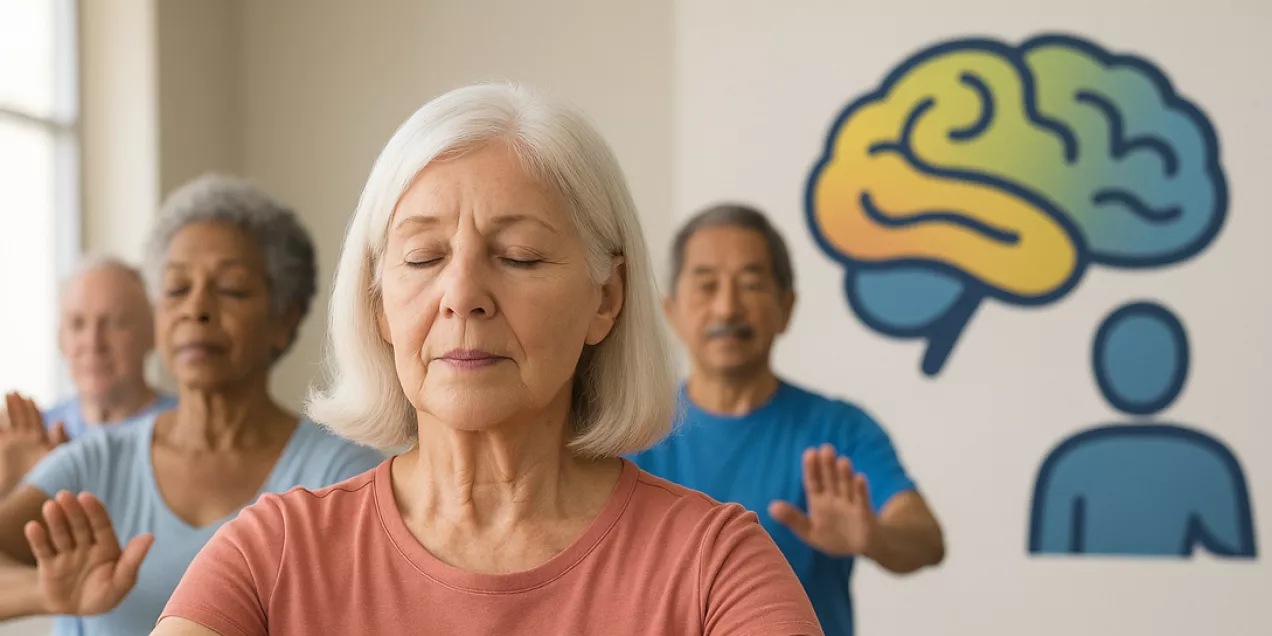
To test this theory, researchers at the San Francisco VA, UCSF, and UCLA recently completed a new, three-arm, exploratory trial called MOTION (Multi-domain Online Therapeutic Investigation of Neurocognition). MOTION compares Moving Together, an online program that integrates mindful body movements with social connection, with Tai Chi Chih, a meditation-through-movement version of Tai Chi without the martial arts components. The control arm is an online Health and Wellness Education program.
Learn more about key elements of the three interventions.
Moving Together is based on PLIÉ (Preventing Loss of Independence through Exercise), a program the researchers developed and tested in consultation with many front-line practitioners from a variety of movement modalities including physical and occupational therapy, dance movement therapy, Tai Chi, yoga, Feldenkrais and Rosen methods. Previous studies by this research team have demonstrated that cognitively impaired adults who participate in PLIÉ or Moving Together show significantly improved quality of life and their care partners are better able to manage stress.
Similarly, prior research suggests that Tai Chi’s strengths as a mind-body exercise program can outperform conventional physical exercise and health education for regulating mood and depression.
Participants were randomly assigned to one of the three study arms. Data is collected at baseline, post-intervention at 12 weeks, and at a 6-month follow-up. The data collection includes cognitive and physical assessments, self-report questionnaires, and MRI scans (at baseline and post-intervention). Secondary outcomes include measures of specific cognitive domains such as executive function, attention, memory, processing speed, as well as mobility and psychosocial well-being (e.g., mood, mindfulness, social isolation).

Linda Chao, PhD, described the trial, “Preliminary data suggest no significant differences between the groups in cognitive or self-report psychosocial measures. We were surprised that the Health and Wellness Education was as effective as it was. However, initial analysis of the neuroimaging data suggests that Moving Together may help slow down the disease progress in participants with MCI and subjective memory decline.”
Dr. Chao of the San Francisco VA Medical Center and the Department of Radiology and Biomedical Imaging at UCSF, is first author of Multi-domain Online Therapeutic Investigation of Neurocognition (MOTION) - A randomized comparative-effectiveness study of two remotely delivered mind-body interventions for older adults with cognitive decline, published in Contemporary Clinical Trials