
UCSF Offers Histotripsy: Non-Invasive, No-Radiation Liver Cancer Treatment
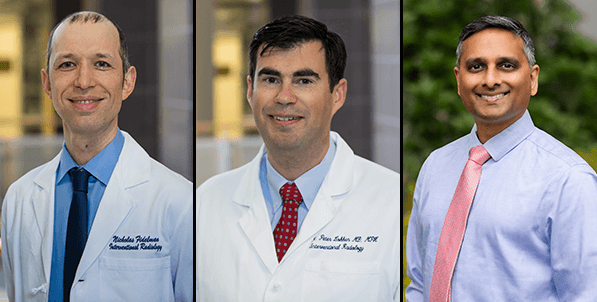
UCSF is proud to be the first health system in the Bay Area to offer histotripsy to patients with primary or metastatic liver tumors. Interventional radiologists – Nicholas Fidelman, MD, R. Peter Lokken, MD, and Rajesh Shah, MD – are specially trained to deliver this new, FDA-approved treatment to patients who meet certain criteria.
“We are excited to offer this state-of-the-art treatment in consultation with our colleagues in medical oncology, surgery, and hepatology,” Fidelman said. “I am very thankful to our department chair, Dr. Chris Hess, for investing in this technology and placing UCSF at the forefront of this sought-after treatment option.”
K. Pallav Kolli, MD, chief of interventional radiology, said that “Histotripsy adds to our armamentarium for liver tumors, offering a non-invasive technique with curative intent.”
What is histotripsy?
Histotripsy is a precise, zero radiation procedure that uses high-frequency focused ultrasound waves to destroy liver tumors.
Ultrasound waves are concentrated on a tumor, creating micro-bubbles that rupture and destroy the cancer cells from within. Cavitation is the term for this process. The body’s immune system then disposes of this acellular debris. This safe, precise method can treat liver tumors located near vital structures without damaging healthy tissue.
Who is a candidate for histotripsy?
Histotripsy is an option for patients with primary cancer of the liver or metastatic tumors to the liver that are visible on ultrasound. A single tumor can be up to 5 cm in size. Multiple tumors should be smaller than 3 centimeters in size.
This technology may be an option for patients who are not candidates for traditional ablation, surgery, or radiation therapy. Histotripsy may also be an option for patients with tumors located very close to critical structures, which may be difficult or unsafe to treat with other modalities.
Histotripsy is not suitable for patients with many tumors or tumors in the uppermost portion of the liver near the lungs, ribs, and heart.
Patient Experience
- When a patient’s physician determines that histotripsy is a treatment option, they make a referral to interventional radiology at UCSF.
- Our interventional radiologists review each patient's history. If histotripsy is indicated, the patient meets with the UCSF interventional radiology team to discuss a treatment plan. Clinicians may perform an ultrasound exam to determine whether the tumors are visible by ultrasound.
- When a patient is approved and scheduled for histotripsy, they typically arrive in the morning at UCSF’s Mission Bay Hospital.
- During the histotripsy procedure, patients lie on a table under general anesthesia to maintain precise positioning and sustained shallow breathing. This minimizes movement in the targeted area.
- The treatment head, which emits the sound waves, is placed inside a soft, flexible membrane containing degassed water. The membrane is positioned on the abdomen and directed at the liver tumor. This ensures optimal transmission of the ultrasound waves.
- Treatment can last for several hours depending on tumor size and extent.
- Recovery time after the procedure is minimal. With no incisions, patients can expect only minor side effects such as fatigue or nausea from the anesthesia. If patients experience pain at the treatment site, their provider can recommend or prescribe an analgesic. Patients typically return home within 24 hours.
Histotripsy Can Stimulate a Powerful Immune Response to Cancer
In some human case reports and animal models, histotripsy has been shown to stimulate a strong immune response against other tumors elsewhere in the body, known as the abscopal effect. While the mechanism is not fully understood, it appears that destroying tumor cells with histotripsy may release antigens — biological material that activates the immune system, allowing it to recognize and kill cancer cells.
Kolli notes that harnessing the abscopal effect is an exciting area of ongoing research where the goal is “identifying how to take this rare reaction to histotripsy and make it an expected reaction when paired with other therapies. While histotripsy is not yet approved for treating tumors outside of the liver, this technique has enormous potential for improving how we treat systemic disease.”
To self-refer for histotripsy, please call the interventional radiology scheduling team at (415) 353-1300.