
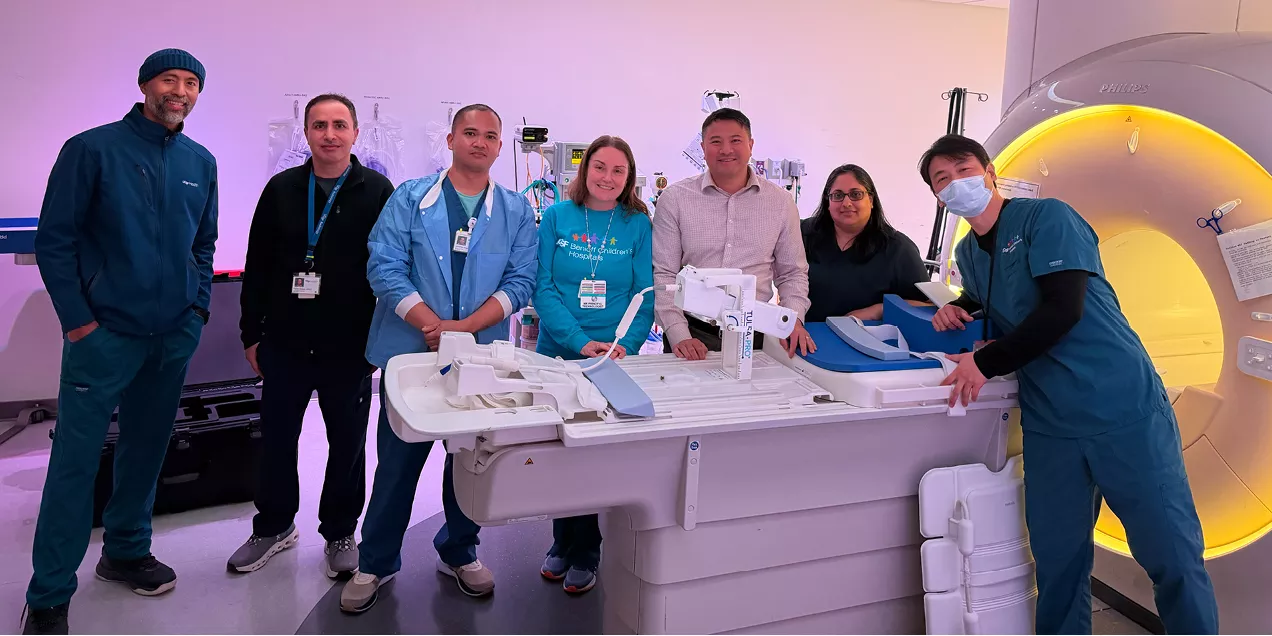
Urologists and Interventional Radiologists at UCSF Treat Prostate Disease with TULSA
Ryan Kohlbrenner, MD, interventional radiologist at the UCSF Department of Radiology & Biomedical Imaging, is leading a new prostate disease treatment program at Mission Bay. He explains the TULSA Procedure and what eligible patients can expect.
The TULSA Procedure – short for transurethral ultrasound ablation – is a minimally invasive, incision-free way to treat prostate disease with MRI guidance and precisely focused ultrasound thermal energy. Kohlbrenner describes it as a unique option for some patients with benign prostatic hyperplasia (BPH) or prostate cancer.

There are a lot of procedures for benign prostatic enlargement and a lot of procedures for prostate cancer, but nothing quite like this.
How It Works
The procedure is a collaboration between interventional radiology and urology. At UCSF, Kohlbrenner works alongside urologists Max Bowman, MD, and Hao Nguyen, MD, PhD. With the patient under general anesthesia, a urologist places an MRI-compatible probe through the urethra into the prostate. From a separate workstation, the care team maps exactly which tissue needs to be treated. The device then automatically rotates and ablates only those targeted areas while protecting surrounding healthy tissue. The procedure takes approximately three hours, and most patients go home the same day.
That precision is meaningful. For BPH patients, structures like the ejaculatory ducts can be spared, which is not always possible with traditional surgical approaches. For patients with a localized prostate cancer, treatment can be directed to just that region. For patients dealing with both conditions simultaneously, Kohlbrenner notes that TULSA can improve urinary symptoms and treat the cancer.
What Patients Can Expect
Recovery involves a few weeks when urinary symptoms may temporarily worsen as treatment-induced inflammation subsides, after which most BPH patients experience improvement in frequency, urgency, and stream strength. Five-year clinical trial data in patients with low- to intermediate-risk prostate cancer suggest favorable genitourinary quality of life outcomes with regard to urinary continence and erectile function.
Why Choose UCSF for Prostate Care
For Kohlbrenner, offering TULSA at UCSF is a natural fit. The procedure’s reliance on MRI guidance aligns with UCSF’s existing imaging expertise, and the program joins a growing number of UC institutions that have embraced the technology. “I think that speaks to the technology and the patient satisfaction associated with it,” he shares.
For patient interested in learning more, the first step is a conversation with their doctor. Most will come to the program through a physician referral, connecting with the UCSF team through urology or interventional radiology. The procedure is Medicare-covered for eligible patients.