
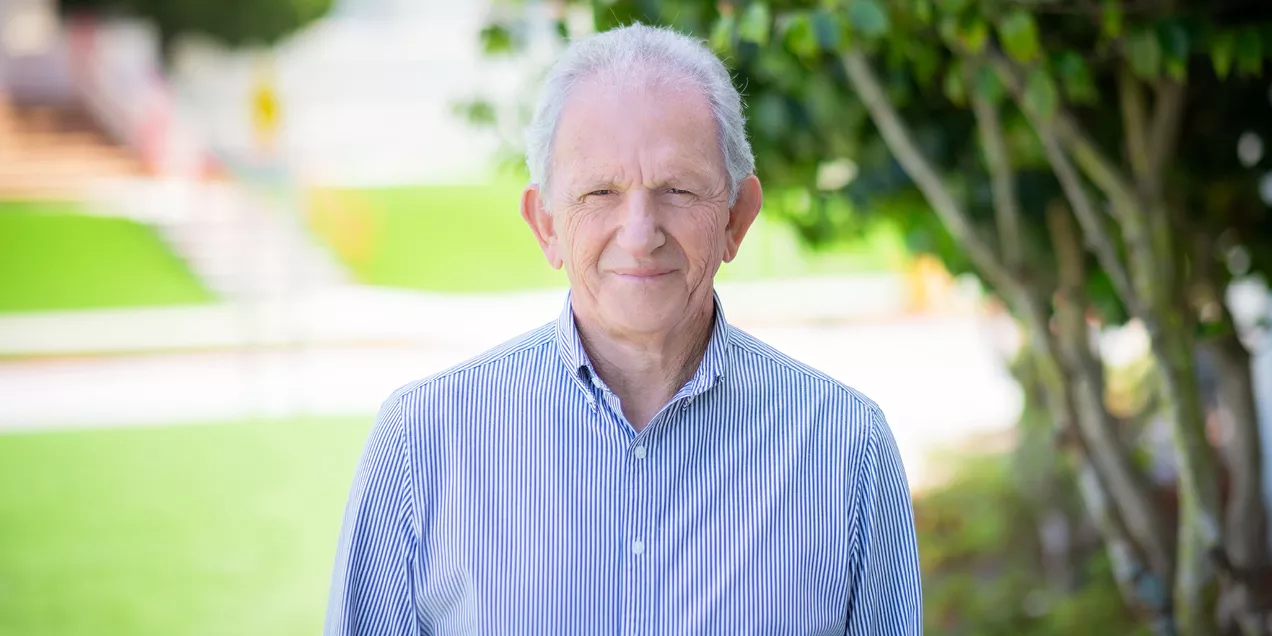
Research is a Spiral: David Saloner, PhD, on the Long View of Discovery
After 25 years leading the Vascular and Cardiac Research Center, David Saloner sat down with us to reflect on new developments in the Vascular and Cardiac Imaging Research Group with the recent recruitment of Zhaoyang Fan, PhD, as co-director.
Hearing Saloner describe himself paints a very humble picture, one at odds with his record of accomplishments. His publications include hundreds of highly cited papers. His decades of work in atherosclerosis, aneurysm, pulsatile tinnitus, and stroke have advanced each of those fields. So many projects over the years were the foundation for another branch of research, and yet Saloner depicts his scientific career as one of process and pragmatism.
“Research is like a spiral,” he said. “You often go around in a circle but hope that when you return to the same spot you’ve moved up a bit. You don’t only learn from when things work well. You also learn from when they don’t.”
His career has taken turns as well. Before he entered imaging science, Saloner began as a student in mathematics and physics, pursuing a PhD in theoretical nuclear physics at Karl-Ruprecht University in Heidelberg, Germany. From the beginning, he was captivated by the laws that govern the universe, the hidden structures and mechanisms that explain why things behave the way they do. He describes it almost like abstract art: physics is an effort to visualize unseen dimensions of reality simply for the joy of understanding them. Yet even as he immersed himself in theoretical physics, he sensed something missing.
“It was fascinating,” he reflected, “but also isolating.” Explaining Lagrange equations over dinner was not always an easy bridge between academic life and the everyday world. He began searching for a path where quantitative science could intersect more directly with human experience and societal benefit. That path emerged through medical physics, which he first encountered at the University of Wisconsin, Madison.
Saloner’s experience and willingness to start on a different path gave him experience and insight that, over the years, has benefitted many UCSF trainees. An annual attendee of ISMRM, he can walk the hallways and see UCSF graduates who have gone on to other institutions, PhD programs, or careers in medicine. He says, “It’s an indescribably rewarding feeling to know that you helped people reach a place where they’re clearly finding fulfillment.”
While he reached for his own fulfillment in medical physics, Saloner encountered clinicians who were studying phonation and speech impediments using X-ray imaging to analyze tongue position during speech. He wondered if there were a better way to answer the question. The work sparked Saloner’s interest in medical imaging as a means to apply physical principles to pressing clinical questions.
At the time, nuclear magnetic resonance imaging was still in its infancy. However, Saloner recognized its extraordinary potential and began exploring how this emerging technology could complement existing X-ray techniques. With an MRI research focus, he pursued a postdoctoral fellowship in medical imaging at Wake Forest School of Medicine. There he worked with Dick Moran, PhD, whose pioneering work in magnetic labeling of blood flow helped establish techniques still used today. The experience was foundational in shaping Saloner’s enduring interest in cardiovascular physiology, blood flow dynamics, and translational imaging science.

Saloner still finds the greatest fulfillment in translational research, allowing him to connect physics insights directly to clinical need. He explained, “As a researcher, you may have technical skills, but if you don’t understand the needs of your clinical colleagues, you could spin your wheels making a very pretty tool that isn’t of use to anybody.”
That philosophy has shaped much of his research career, particularly his investigations into cardiovascular blood flow and atherosclerotic disease. Soon after arriving at UCSF and the San Francisco VA Medical Center in 1987, Saloner contacted the vascular surgeons, asking them which problems most troubled them in practice. Again and again, the same challenge emerged: determining when obstruction in the carotid arteries required surgical intervention. As he formulated his research approach, Saloner spent hours in surgeons’ offices learning how they evaluated patients, how they interpreted symptoms, and where uncertainty remained. By immersing himself in the clinical problem, he could begin to understand the underlying physics that imaging might help reveal.
That cross-disciplinary curiosity has opened up many research avenues for him. While attending cerebrovascular rounds, Saloner heard clinicians discussing pulsatile tinnitus. At the time he knew little about the condition but his background in carotid blood flow immediately sparked a connection. In vascular disease, turbulent blood flow can sometimes be heard through a stethoscope. Saloner wondered whether similar turbulent dynamics close to the ear might also explain sounds perceived within the brain.

The question launched an entirely new line of investigation, bringing Saloner into collaboration with neurointerventional radiologists to study flow dynamics and vascular turbulence in previously unexplored territories from the perspective of a physicist.
“I always encourage my students to think about mechanism,” he said. “What makes things do what they do?”
As a newly minted UCSF professor, one of those mechanisms he encountered was the cycle of grant funding and project development that characterizes academic research. As a PhD faculty member whose work depended on external funding, he felt pressure to pursue projects that were both scientifically meaningful and financially viable. With this mentality came the temptation to chase every promising new idea, observing that, “There’s always another shiny object.”
In those early days, Saloner found himself often trying to solve problems independently rather than drawing upon the expertise around him. However, he came to recognize the importance of collaboration, mentorship, and careful stewardship of time and energy. He now advises researchers starting their careers to learn from the evolutions of his career. He says, “Reach out to your community. Senior people in your department have gone through these same challenges. When I was starting out, I made many errors I could have avoided by letting someone guide me.”
That spirit of standing on the shoulders of fellow scientists allows Saloner to love the slow spiral of medical research. Each generation of imaging technology prompts researchers to revisit longstanding questions with greater precision and deeper insight. Over decades, Saloner designed longitudinal studies that enabled him to follow some patients annually for more than twenty-five years, creating rare opportunities to observe how disease evolves over time.
“You form a connection,” he reflected, “and you understand that your work makes a difference in their life, providing comfort and information about the condition they’re living with.”
Walking steadily along that winding path, Saloner remains deeply interested in the progression of disease across time. Imaging captures moments, but understanding how disease develops, adapts, and changes remains central to advancing patient care. In conditions such as atherosclerotic disease and aneurysmal disease, those insights can carry life-or-death implications.
Looking ahead, Saloner sees enormous promise in artificial intelligence and its ability to accelerate scientific discovery and personalize medical care. By integrating vast quantities of data, AI may uncover relationships that were previously hidden behind the sheer scale of manual analysis. At the same time, he remains thoughtful about the role of human curiosity in discovery. He worries that excessive reliance on automation could diminish the exploratory instincts that often lead to true innovation.
“To be found,” he said, “you must first get lost.”
For Saloner, getting lost is not simply a metaphor for research, it is also one of the great pleasures of travel. Whether exploring the landscapes of his native South Africa in search of sable antelope or wandering down an unfamiliar side street in a distant city, he values the unexpected encounters and discoveries that emerge off the planned path.
Those moments of curiosity, detour, and exploration have shaped both his scientific career and his understanding of the world.
| Organization | Year | Honor |
|---|---|---|
| Master of Science in Biomedical Imaging | 2020 | Best Teacher Award |
| Department of Radiology and Biomedical Imaging | 2018 | Faculty Mentoring Award |
| International Society of Magnetic Resonance in Medicine | 2017 | Fellow |
| Academy of Radiology Research | 2013 | Distinguished Investigator |
| American Institute for Medical and Biological Engineering | 2012 | Fellow |
| University of California, San Francisco | 2009 | Nominated Lifetime Achievement Award in Mentoring |
| Society of Magnetic Resonance Angiography | 2003 | President |