
Meet Dr. Lin – A Driving Force Behind 3D Modeling
No two hearts are the same. And no one knows that better than Shezhang Lin, MD.
Lin spends his days creating detailed, interactive, models of patient’s hearts at UCSF’s 3DLab. His 3D heart models help surgeons visualize a patient’s heart before surgery, to better understand and address the unique case at hand, to plan the best surgical approach, and to help explain complex procedures to patients and their families.
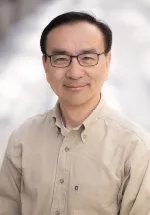
Every case is different, I love the challenges of 3D imaging
Lin, image analysis and visualization lead at the 3DLab, a resource within the UCSF Center for Intelligent Imaging (ci2). The 3DLab provides advanced image processing to enhance clinical diagnosis, surgical planning, treatment planning and response, surgical training, intra–operative navigation, and patient education.
“With the rapid pace of new technology development, we’re always moving forward to more challenging and more useful tools for the most complicated diseases.” said Lin, who has more than 30 years of experience in the field.
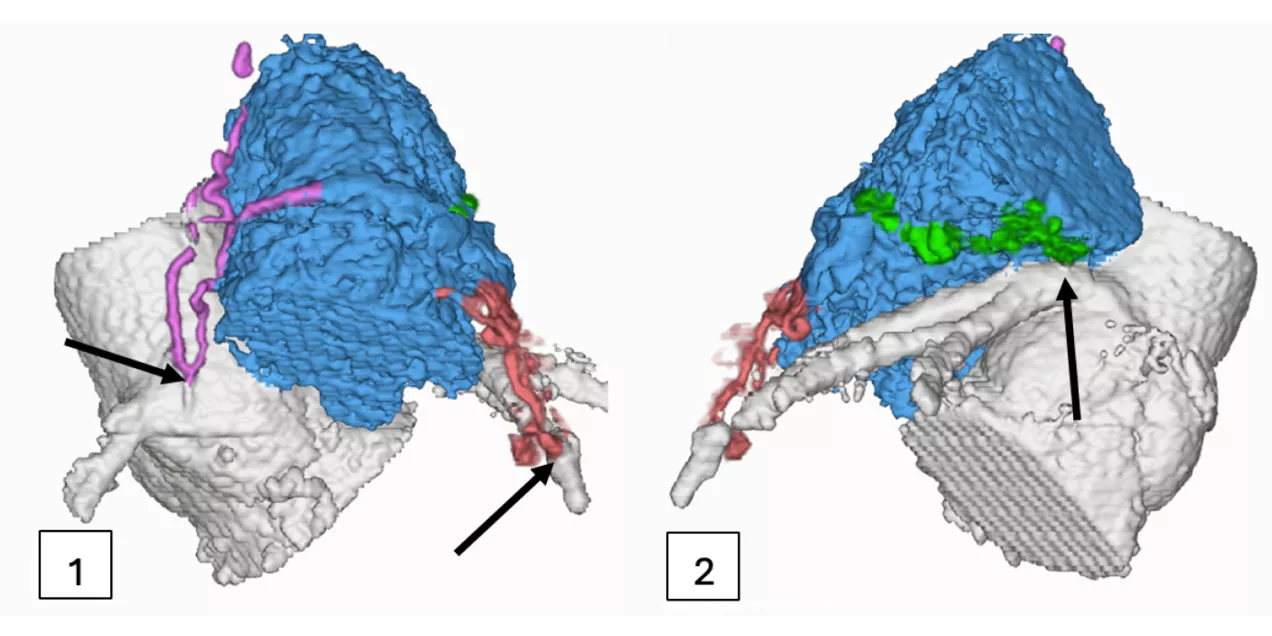
The 3DLab uses a comprehensive suite of state-of-the-art technology to create 3D models to address a wide range of complex medical problems and offer solutions for many medical conditions. Since joining the 3DLab in 2017, Lin has refined his expertise in harnessing the power of these technologies to provide advanced 3D visualizations that reduce radiologist reading times, improve diagnostic accuracy and presurgical planning, decrease costs, and improve overall patient care. Featured in the hero image, color-coded 3D models demonstrate how this technology can reveal complex anatomy not clearly defined on traditional 2D CTA images. In this case, the models helped clinicians visualize tortuous coronary branches and identify the origins and courses of three coronary fistulas. “I can’t see the LM well on CT, but the 3D reformats are very helpful, thank you!” one physician noted.
In one case, color-coded 3D models provided front and left-posterior views of complex coronary anatomy that was not clearly defined on 2D CTA images. The models revealed numerous tortuous coronary branches between the aorta and main pulmonary artery and helped identify the origins and courses of three coronary fistulas arising from the left main, left anterior descending and right coronary cusp. The added clarity proved valuable to the care team. “I can’t see the LM well on CT, but the 3D reformats are very helpful, thank you!” one physician noted.
Lin specializes in cardiovascular projects, using advanced image processing tools to provide three-dimensional models and visualization services for aortic diseases, coronary artery diseases, atrial fibrillation, transcatheter cardiac valve replacements, congenital heart diseases, and DIEP/breast reconstruction. Last year, based on cardiologist’s request, Lin managed the development of a new opportunity for the lab to provide visualization services for mitral valve replacement procedures.
“I enjoy working with radiologists and surgeons to develop new projects. Then I create the protocol and provide training to our team members,” said Lin. In addition to creating 3D models, he’s also responsible for project management, project development and training.
Prior to UCSF, Lin was a 3D specialist at Harvard’s Beth Israel Deaconess Medical Center and held roles as an assistant professor at Georgetown University and a research fellow/assistant professor at Northwestern University. He was also a chief radiologist and director of the 3D Imaging Lab at Haikou Hospitals in Haikou, China.
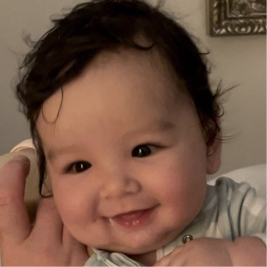 When he’s not at the lab, Lin enjoys practicing Tai chi for exercise, spending time with family, and cooking. This year he became a grandfather and he’s looking forward to spending more time with his daughter and 6-month-old grandson.
Just like he does at work, Lin is always driving himself toward the next challenging project. When it comes to cooking, he’s mastered the regular dishes of fish, shrimp, and beef, and now he’s moving on to the challenge of learning to master lobster.
“Very tasty, and very challenging,” Lin says with excitement.