
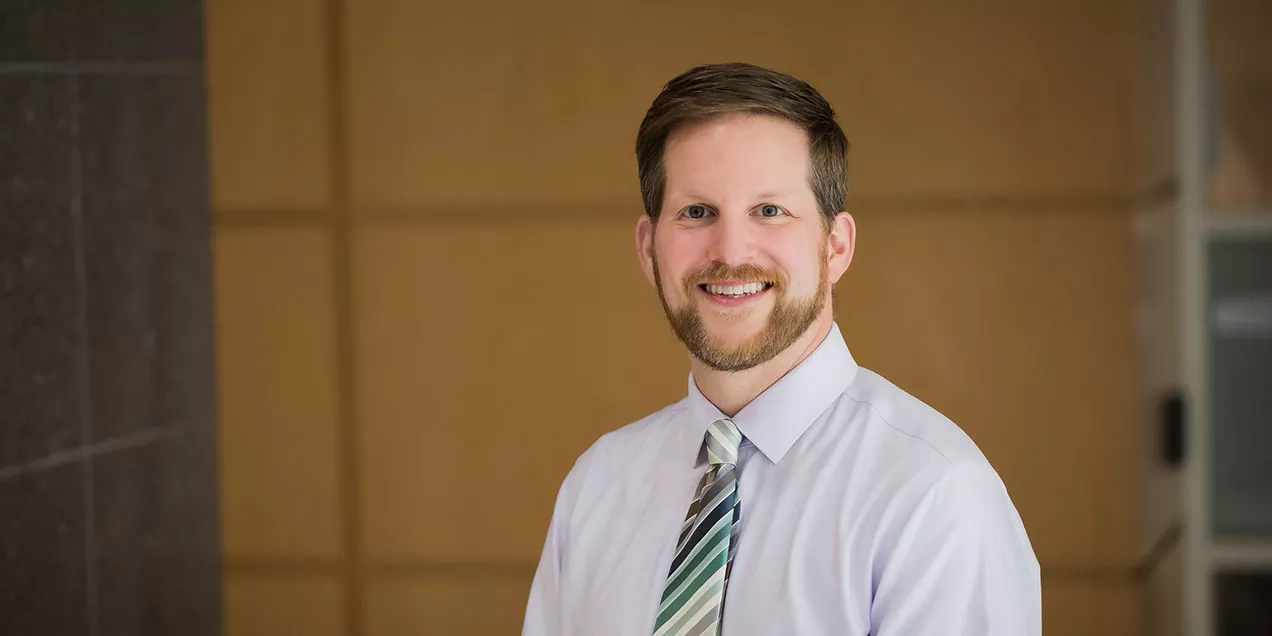
This year, Joseph “Joe” Leach, MD, PhD, won the 2026 Exceptional Physician Award, given to just a few UCSF Health physicians who provide outstanding patient care. The path that led to being a physician has had many turns, but it has always been shaped by an appreciation for complexity and interconnectedness.
Joe's first two loves were music and physics. He’s played the guitar for nearly 40 years in many genres, though mostly jazz and metal, often with blurred boundaries. Music is always on his mind, and he finds beauty in its simplest to most complex and even chaotic forms.
This awareness of beauty from the simple to complex led to Joe’s deep interest in physics and mathematics. He found his academic work and research in quantum mechanics very engaging, yet he always felt some need for a more grounded application of the mathematics. Exposures to CT and MRI physics as an undergraduate were the earliest connections between his academic passions and his growing fascination with medicine.
In his early twenties, while still pouring 50% of himself into music, Joe worked in Cleveland, Ohio as a physicist for a medical device company developing needle-sized arthroscopes for orthopedic applications. His team hoped to extend this technology to a combined optical/spectroscopic platform for evaluating atherosclerosis in larger arteries, and as part of the process Joe consulted with vascular surgeons at the Cleveland Clinic. He collaborated with surgeons to figure out what would be clinically useful, and how such a device could be implemented. Through those conversations and the exposure to cutting edge endovascular surgery, Joe developed an abiding fascination with vascular imaging.
Joe was entranced by the angiographic depiction of blood vessels, “You're either struck by the beauty of this arboreal branching pattern of vessels, or you’re not.”
With a more defined connection between his academic interests and a real application, Joe decided to pursue a PhD in the joint UCSF-UC Berkeley Bioengineering program, where David Saloner and his work in vascular imaging stood out. Working with real clinical data, alongside inspiring scientists and clinicians, Joe began to see the path toward his future. He credits Dr Saloner as being patient, supportive, and ever-encouraging as his goals grew beyond graduate school to include pre-med coursework, medical school applications, and a plan to pursue a career in radiology, where he could not only continue his academic pursuits, but apply his interests clinically to benefit patients in real-time.

Today, Joe is an abdominal radiologist who conducts research living at the intersection of imaging and vascular biomechanics. Through mostly computational analyses, he works to understand the mechanobiology of abdominal aortic aneurysm progression and rupture risk, which he sees as pertinent to both patients and their clinicians. As Joe describes it, “The blood vessels are a perfect playground where imaging and physics can be coupled to investigate interesting questions.”
The current standard for assessing aneurysm risk relies on manual diameter measurements and tracking their change through time. Joe and his colleagues hope to extend this analysis to include other aneurysm characteristics that can be observed at imaging. Biomechanical stress, 3D geometry, aneurysm composition, and inflammation are all suspected to play their own roles in aneurysm risk, and Joe and his team have developed a pipeline to bring all of these features into one shared analytical framework, where they can be viewed alongside spatially resolved maps of aneurysm progression.


Joe enjoys his job most when he has the opportunity to make a direct and significant impact to a patient’s care. Sometimes that’s walking a patient through their imaging results in person or over the phone. Sometimes it's supporting them through a biopsy. Joe enjoys meeting patients on their level and delivering the information they need in a comfortable way. The most rewarding days, however, are when he’s able to diagnose or characterize an issue in a way that will help referring clinicians understand a complex patient or condition and provide the best care.
Even with a busy clinical schedule and continuing research efforts, Joe still manages to dedicate 110% to his 3-year-old daughter Frankie and make time for music. This summer he’ll be in Ohio for a reunion of his old band, whose name is “too long and too weird to get into here” according to Joe. The group will play together for the first time in almost two decades.
Joe is grateful his journey brought him to UCSF, and says it has been the perfect place for his development. “Some people know the thing they’re passionate about intrinsically and simply get to it. For me it’s been a long trajectory; starting out as somebody who wanted to understand how images were made, then how to interpret them, and ultimately I’ve learned what to do with that information.”