
UCSF Health Nurse Practitioner and Endurance Athlete Shares His Cancer Journey
FacebookEmailLinkedinThe art of dying is to live very well, Jonathan Pascual believes.
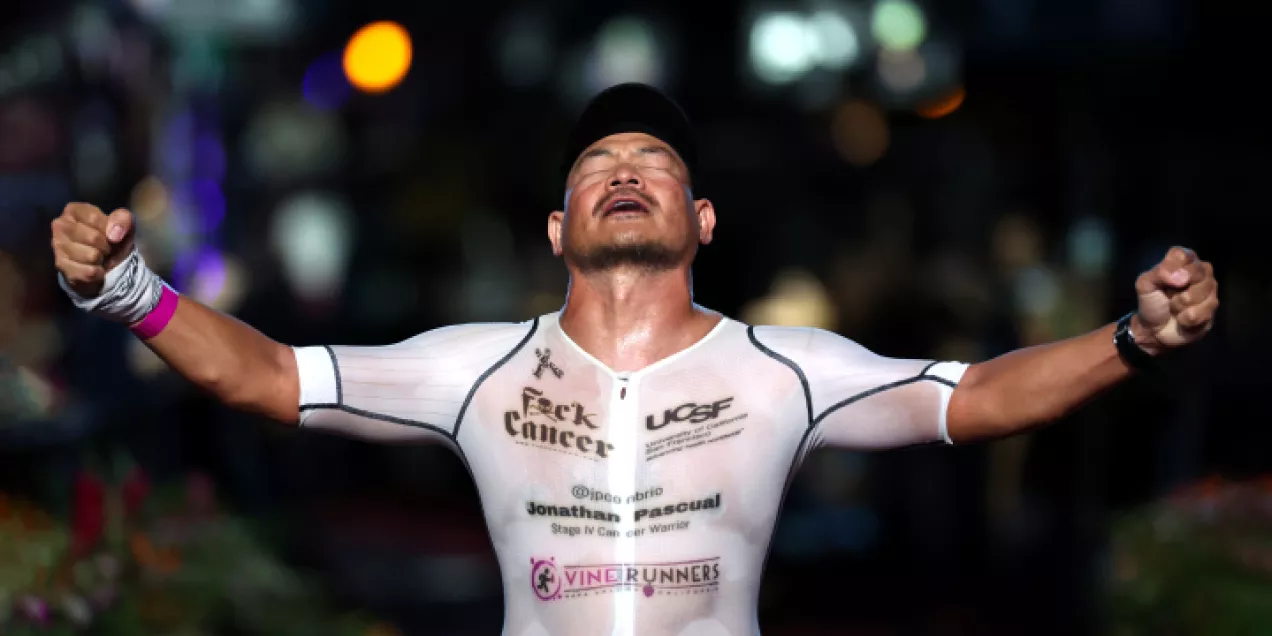
This belief fuels his passion for life and largely propelled him across the finish line of the Ironman World Championship race in Hawaii on October 26, 2024. Competing against the best triathletes from around the world, he accomplished his dream—swimming 2.4 miles in the ocean, cycling 112 miles, and running a 26.2-mile marathon—two years after being diagnosed with advanced cancer.

I want to shatter the misconception that stage IV cancer is a death sentence
In 2022, Pascual, a nurse practitioner at UCSF Health, was diagnosed with mediastinal paraganglioma, cancer of the autonomic nervous system. Doctors discovered a 9-centimeter tumor near his heart and tumors in his spine. His condition was categorized as stage IV when the cancer metastasized, spreading to his lymph nodes, lungs, and throughout his body.
“I know I’m going to lose against cancer. There’s no cure. But to me, I win daily by doing the things that I love to do, and being with the people that I love most,” he said.
Pascual views his cancer as a chronic illness to manage. A 50-year-old endurance athlete, he refers to his pain as “the discomforts” while he trains, as he’s done for the last 20 years, to compete in triathlons and ultra marathons. He’s completed 15 Ironman competitions, which qualified him for entry into the prestigious championship event in Hawaii.
“As a healthcare worker, I’ve seen people go through the suffering of illness. Some we help get better but some we can’t, and then they transition to the other life,” he said. “It gives you a sense of clarity about what is really important and that takes practice.”
A Caregiver Becomes the Patient

Pascual, who joined UCSF Health in 2000, is currently a nurse practitioner at the UCSF Lung Transplant Program, where he cares for patients before and after lung transplantation. He’s worked with the lung transplant team for 10 years and is proud that the program grew to a record of 116 transplants last year. Previously, he helped build the Mechanical Circulatory Support (MCS) program at UCSF in 2004, which uses mechanical heart pumps to care for patients with advanced heart failure.
His personal health journey started in 2007, when he was diagnosed with a brain tumor. Cared for by his colleagues in Neuro Intensive Care, he had surgery to remove the tumor and recovered well. Within three months, his doctor gave him the green light to train for his third Ironman triathlon.
He felt healthy for many years until early 2022, when he experienced dizziness and shortness of breath—to the point of fainting upon standing on a few occasions.
“I thought I wasn’t training hard enough and told myself to get to work,” he said. “Then, I was going to go for a 22-mile run and wondered, ‘why am I getting fitter and leaner, but I’m short of breath, my face is bloated, and the veins in my neck are thick as ropes?’”
He knew something was wrong and following the advice of his colleagues, he went to the emergency room at UCSF Medical Center on March 24, 2022, which led to a series of diagnostic imaging procedures.
“As soon as I saw the CT scan, I knew I had cancer—even before the doctor told me that what we’re seeing in the images was most likely cancer,” he said.
A Journey Toward Cancer Stability
“I had to look at my life daily and decide how I wanted to live it,” he said.
Working with a team of specialists at UCSF Health, he underwent treatment that included a combination of radiation therapy and nuclear medicine treatment.
“Our main goal was to stabilize the cancer and reduce the size of the tumors,” he said.
Using high-dose, precisely targeted X-rays in radiation therapy, his tumor cells shrunk with minimal damage to surrounding healthy tissues.
Pascual's care team included medical oncologist Claire Mulvey, MD, and radiologist Thomas Hope, MD, who worked closely together throughout the course of his treatment, which included Peptide Receptor Radionuclide Therapy (PRRT). PRRT is a molecular therapy often used to treat neuroendocrine tumors (NETs) using a radioactive substance that is attached to a peptide designed to bind to receptors on the surface of tumor cells.
“For Jonathan, although PRRT has not removed the majority of his tumors, stabilizing his disease has allowed him to do the things that he enjoys,” said Hope.
“I am amazed by the joy that Jonathan brings to life. He does not let his cancer define the road he will travel,” Hope added. “We often see our patients through the images we take, but there is no relationship between Jonathan’s smile and what one can only call extensive metastases on his imaging.”
Chief of Neuroradiology Vinil Shah, MD, treated Pascual with kyphoplasty – a minimally invasive surgical procedure that stabilized vertebral compression fractures caused by the cancer in his spine – to reduce pain and restore the affected vertebrae for better mobility.
“It was overwhelming to be taken care of by my friends and colleagues. I felt so loved and supported,” he said. “So many people come together to take care of you. I’ve seen them in the hallway, and we’ve said good morning for so long, and now I’m on the other side, and it feels different. It’s a very humbling experience.”
He got through the most difficult days by staying focused on achieving cancer stability through his treatment at UCSF, through complementary medicine—including the barley tea his wife got from the Philippines—and with exercise and rest. And most importantly, he focused on building a support system that opened him to loving care from others.
Pascual still experiences the ill effects of both his cancer and his radiation treatments, including shortness of breath, swelling around his face and neck, and neuropathies that cause numbness and tingling in his arms and legs. To manage his shortness of breath, he must slow down his pace when running, swimming, and biking, but he doesn’t let that stop him.
“I get my mind busy. I go to work. I work out, and once I start doing other things, I’m no longer focused on all those discomforts,” he said.
A Celebration of Resilience
Reflecting on his cancer journey, it became important for Pascual to celebrate his resilience by bringing his community together. He created JP’s Backyard Ultra, a running and hiking event at the Skyline Wilderness Park in Napa, supporting the Fxck Cancer foundation, a nonprofit dedicated to cancer prevention, early detection, and providing support to those affected by cancer. He planned the event for his friends and their families, and designed the course as a series of loops, so that whether participants walked or ran, they started together. In fall 2024, more than 350 people joined, raising more than $14,000.
“That was such a fulfilling and gratifying day,” said Pascual. “To see my triathlon group, my running group, my cycling group, my family, my work family, and so many other people that have touched my life enjoying each other’s company. My goodness! What a celebration of life.”
Today, he continues to monitor his cancer with regular imaging. Depending on what the scans show, or if he becomes more symptomatic, he may resume cancer treatment in the future.
He continues to work at UCSF part-time and shares his inspiring story through speaking engagements. Recently he visited to his son’s former high school and spoke to students, many of whom have also been affected by cancer directly or through the experience of a family member or friend. He stresses that cancer can be a long journey, and he highlights the importance of reaching out to those affected, not just after a diagnosis, but in the months and years down the road.
“What really touched me is that I realize I’m carrying this terminal disease, but I have also been carried by my village to where I am now,” he said. “It’s my UCSF community, my caregivers, my family, my friends, and so many others, even strangers who have reached out to me—that is the most touching and heartwarming part of this journey.”
Peptide Receptor Radionuclide Therapy
Peptide Receptor Radionuclide Therapy (PRRT) is a targeted cancer treatment that uses a radioactive substance (radionuclide), attached to a peptide (DOTATATE), to deliver radiation directly to neuroendocrine tumors (NETs).
How PRRT works:
The peptide is designed to bind to somatostatin receptors found on the surface of certain cancer cells. The radionuclide, Lutetium-177, a radioactive isotope that emits radiation, when attached to the peptide, delivers radiation directly to a patient’s tumor cells to treat the tumor.
PRRT is commonly used to treat patients with advanced or metastatic neuroendocrine tumors to control tumor growth, reduce symptoms, and may improve quality of life for patients. There are no available FDA approved therapies to treat paraganglioma, but PRRT can be an effective therapy in a subset of these patients.