
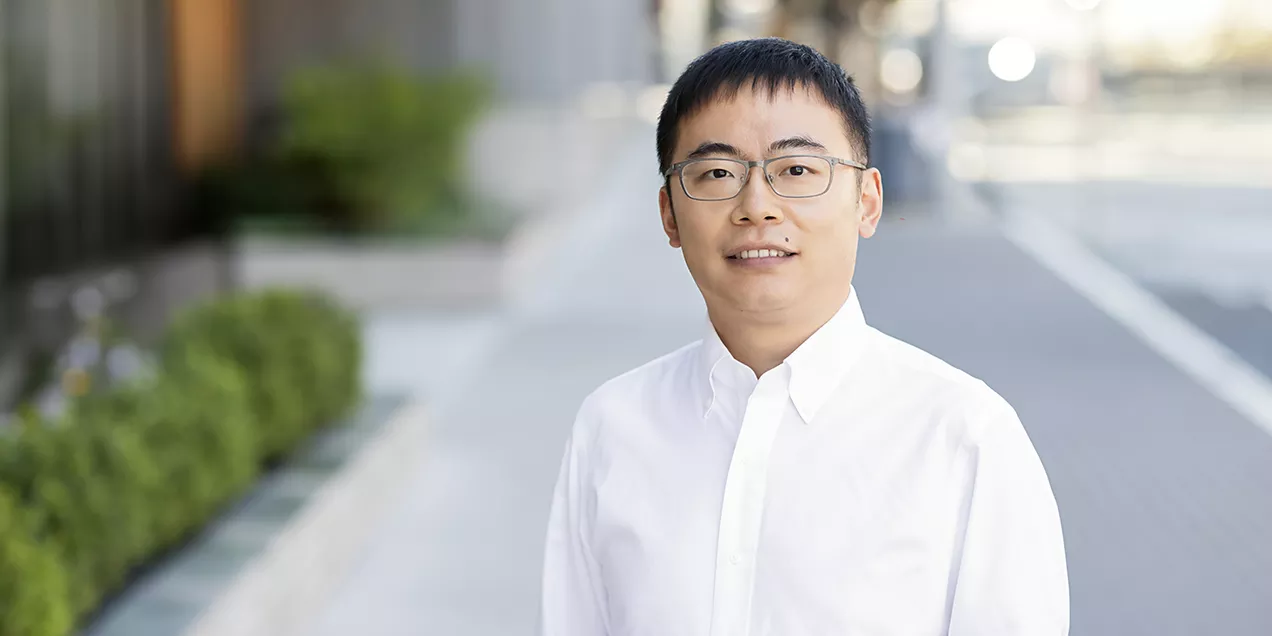
Congyu Liao, PhD, began his studies in geoscience, learning the physics of nuclear magnetic resonance (NMR) and electronics instrumentation, and applying those principles to detect and characterize underground aquifers. When he learned that NMR, also known as MRI or magnetic resonance imaging, was used in medicine he decided to focus his graduate training on developing advanced MRI methods to reveal the organization of the human brain at the finest scale and detail possible.

While Liao’s transition from aquifer geoscience may not be a typical path to biomedical imaging, approaching medicine as a physicist has been his strength. Liao recalled his PhD advisor, Jianhui Zhong at Zhejiang University, observing that “If you have the motivation to do research, you can always learn. It’s not just training for doing a project, it’s developing your ability to resolve problems.”
Liao carried this mindset forward through advanced training in MRI physics and image acquisition at Massachusetts General Hospital and Stanford University, where he worked closely with his mentor, Kawin Setsompop, PhD, professor at Stanford University. Over the past year, Liao has continued to apply this approach by quickly expanding his knowledge of neuromodulation and high-intensity focused ultrasound (HIFU).
Today, as technical director of the UCSF Neuroimaging Technology Research Center (NTRC) and assistant professor in residence, Liao provides a physics-first perspective on developing new techniques for the diagnosis, monitoring, and treatment of neuropsychiatric disease. While clinicians with a background in neuroscience might begin with a goal of what an imaging study should look like, Liao begins with the molecular principles that determine what is possible, “For example, I always think about why the diffusion weighted image looks so unique, why it helps a doctor differentiate lesions and tissue types with unique physical properties.”
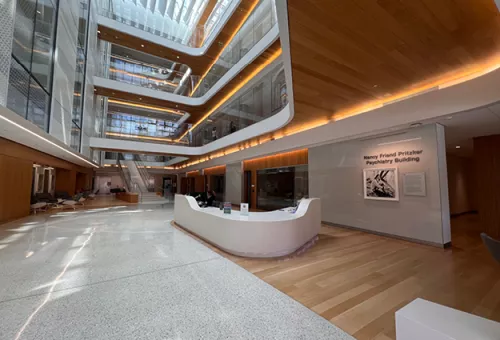
The NTRC – a collaboration between the UCSF departments of radiology, neurology, and psychiatry – drew Liao to San Francisco from Stanford and is a core resource for imaging-intensive clinical trials at UCSF. Reflecting on the power of collaboration across disciplines, Liao observes, “Not everyone is an MR physicist, so I work to present a narrative that will help everyone understand what help we can provide to reach their research goals. There’s a language to such explanation.”
Liao is proud of the NTRC’s rapid growth since its founding in 2025, thanks to the UCSF scientists and clinicians who have established new research collaborations at the center. Imaging resources include two new Siemens Cima.X 3T MRI scanners capable of very powerful gradients with isotropic resolutions of 0.5 - 0.6 millimeters, allowing researchers to investigate the microstructure of the brain in unprecedented detail.
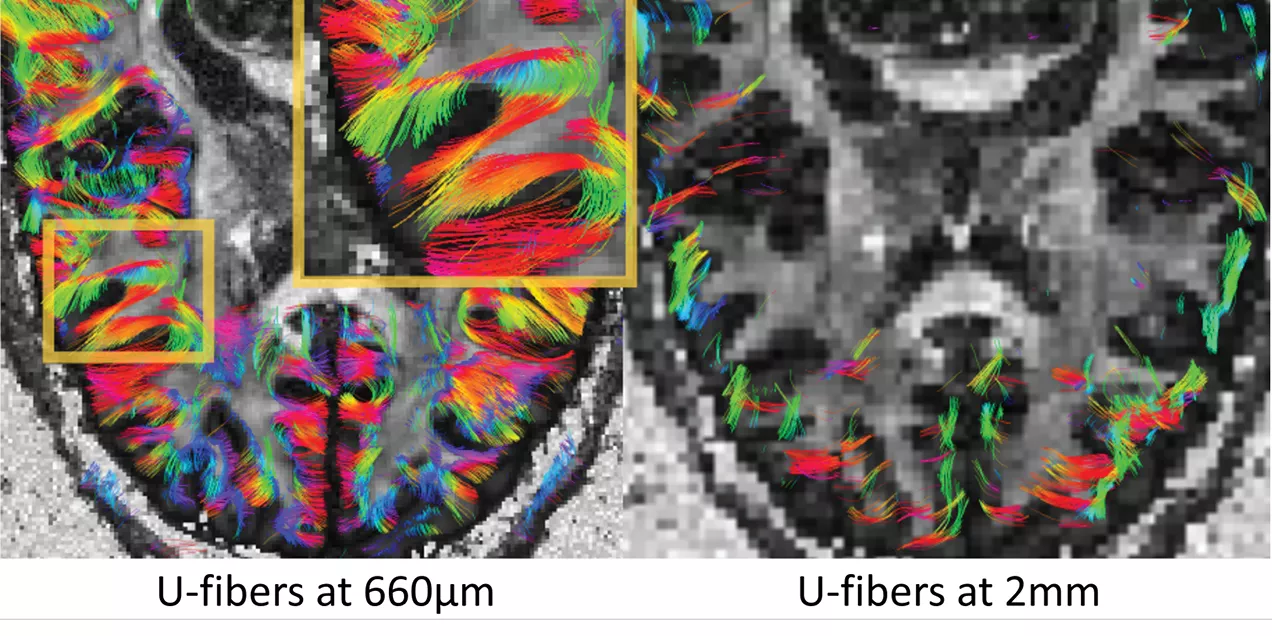
Liao’s own research uses quantitative MRI (qMRI) and diffusion MRI (dMRI) to study how the brain's myelination develops, changes, and deteriorates over a lifetime. He is currently the principal investigator for an NIH grant that aims to develop robust and precise 600µm whole-brain qMRI and dMRI techniques for studying infant brain development. By improving image resolution and fidelity, Liao seeks to better understand microstructural changes in infant brains. “Development and aging are two sides of the same coin,” he notes. “At mesoscale resolution, we can see how the fibers connect to each other in living brains, where before we could only investigate such structures post-mortem.”
As the NTRC enters its second year, Liao looks forward to working with collaborators to develop new imaging technologies that advance neuroscience and neuropsychiatry, with the ultimate goal of translating those discoveries into improved patient care. Reflecting on the development of his own career after his first full year at UCSF, Liao is grateful for his faculty colleagues, with special thanks to NTRC scientific director Leo Sugrue, MD, PhD, Janine Lupo, PhD, associate chair for mentoring and Sharmila Majumdar, PhD, vice chair for research, for their guidance and advice on getting established as an imaging science leader and educator. He is also grateful to Yang Yang, PhD; Salil Soman, MD; Srikantan Nagarajan, PhD; Peder Larson, PhD; and Michael Ohliger, MD, for their mentorship, research support, and valuable collaborations.