
Improving Trauma Care: IR in 60 at ZSFG
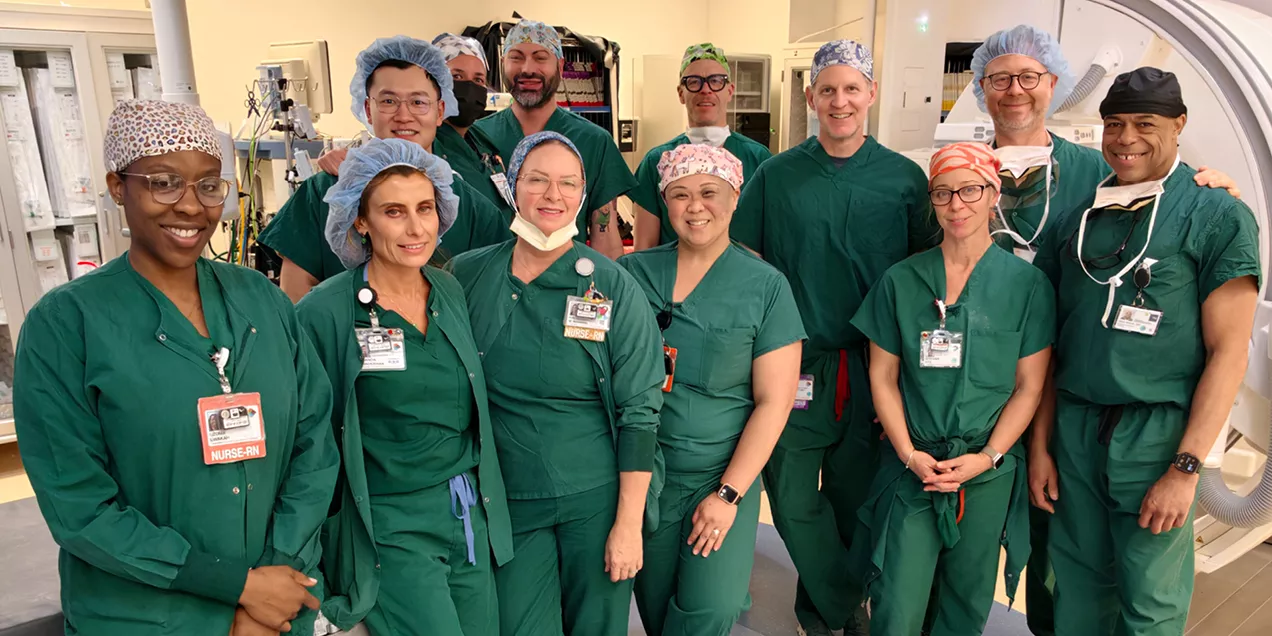
Zuckerberg San Francisco General Hospital (ZSFG) has long been a leader in trauma care, serving as the only Level 1 Trauma Center in San Francisco. Now, ZSFG is tackling a critical challenge: improving the speed and efficiency of interventional radiology (IR) services in trauma cases through a new IR in 60 initiative. Featured above IR in 60 team, with co-leads Timothy Browder, MD, and Miles Conrad, MD, with Mark Wilson, MD, back row, right.
American College of Surgeons guidelines require that trauma centers provide IR services within 60 minutes for patients experiencing life-threatening hemorrhage. This means that once the trauma team and interventional radiologists determine that an IR intervention such as endovascular embolization is necessary to stop hemorrhage, the clock starts ticking. The time between activating IR services and the arterial needle puncture to begin the procedure must occur within one hour.
“We looked at our data through the Trauma Quality Improvement Project [T-QIP], which benchmarks us against other trauma centers nationally, and realized we weren’t quite meeting this metric,” said Timothy Browder, MD, trauma medical director at ZSFG and co-lead of IR in 60. “With a trauma center verification visit coming up in summer 2026, we decided to get ahead of the curve and start brainstorming ways to improve.”
A Collaborative Effort
Improving trauma care is a team effort, and IR in 60 exemplifies this. Interventional radiologist and IR in 60 co-lead Miles Conrad, MD, MPH, observes that “Trauma is the ultimate team sport. Nurses, techs, radiologists, surgeons – everyone comes together with a shared purpose. It’s a huge collaborative effort.”
Reflecting on ZSFG and IR innovation, Conrad noted the legacy of Ernie Ring, MD, a pioneer in trauma IR and past IR chief at UCSF and ZSFG, who performed the first pelvic embolization for hemorrhage control in 1972 using blood clot. “Dr. Ring was an inspiration and his approach to trauma continues to influence how we think about IR today.”
Since the early 1970s, IR and endovascular interventions to stop bleeding have expanded from boutique procedures to standard practice for many solid organ and pelvic arterial injuries. Multifactorial reasons made this shift towards more nonoperative management (NOM) for trauma patients. Advances in clinical research recognize the benefits of splenic preservation, plus endovascular devices such as embolic agents like coils and catheters along with a general drive towards minimally invasive procedures facilitated this evolution. To meet the demand for this care, IR services need to be agile and available 24-7.
Saving Lives with Better Systems
IR in 60 focuses on reducing delays and simplified processes to ensure that patients receive the care they need as quickly as possible. “We’re focused on decreased time for each step and streamlined communication,” said Conrad. For example, the hospital has implemented a universal pager system, like those used for stroke or myocardial infarction cases, to reduce the number of steps required to mobilize the IR team.
Conrad highlighted the importance of coordination: “While we’re mobilizing the IR team, the trauma team is simultaneously working to stabilize the patient. It’s all about optimizing the timing of every step. It’s really awesome when it all works together seamlessly”
Cutting-Edge Infrastructure
ZSFG’s trauma care capabilities are bolstered by state-of-the-art infrastructure, including an IR suite with an integrated CT scanner. This allows the team to quickly identify the source of bleeding and perform targeted endovascular therapy. “Dr. Mark Wilson, our ZSFG radiologist-in-chief, conceived the trauma suite and understood the importance of having a scanner and fluoroscopy unit together in the operating room,” said Conrad. “It puts us at the forefront of what we can do with trauma because everything we need is right there.
Additionally, the IR suite is located within the operating room, behind the red line, which distinguishes it from many other IR suites that are separate from surgical areas. This proximity ensures smooth collaboration between IR specialists and other surgical teams.
Walking Through a Trauma Case
To illustrate how IR in 60 is applied, Browder described a typical trauma case.
Emergency Activation. The process begins when emergency medical services (EMS) stabilize a patient and notify the hospital of their injuries. The trauma team is activated If a patient presents with severe trauma such as low blood pressure, unconsciousness, or significant abdominal injuries.
Trauma Team Arrival. Within minutes, a multidisciplinary team assembles, including trauma surgeons, emergency physicians, radiologists, nurses, respiratory therapists, and lab staff. “A lot of people show up to a full trauma activation,” said Browder. “Everyone has a role – from stabilizing the patient to providing blood products, drawing labs, and taking X-rays.”
Assessment and Stabilization. If the patient has injuries like a pelvic fracture or internal organ damage, the team works quickly to stabilize them with blood products or temporary measures like pelvic wraps.
Imaging and Diagnosis. Once stabilized, the patient is taken to a CT scanner to identify the source of bleeding. Common injuries requiring IR include bleeding in the pelvis, liver, or spleen. “In the last 20 years, interventional radiology has become an essential part of managing acute hemorrhage in these areas,” said Browder.
IR Activation. When IR is deemed necessary, the radiology resident reviews the CT scan and communicates with the trauma team to activate the IR team. “The key is to streamline these steps and minimize delays,” said Conrad.
Enhancing Workflow and Education
Focusing on trauma QI delivers secondary effects. “Our team takes a lot of pride in providing trauma care because it’s a true public health initiative,” Conrad said. “Trauma care seems to also catalyze other multidisciplinary QI projects in IR. We have experienced QI collaborators from anesthesia, trauma surgery, emergency medicine, and radiology but we often work in silos. When we view non-trauma workflow challenges through a QI lens, we see new synergy between our departments. There is a sense that we have real momentum to enact change.”
As part of the Bridges Curriculum, UCSF medical students do an intensive yearlong QI project. Conrad sees the effects of IR in 60 on training, noting that, “Through Bridges, med students are seasoned at QI.” Alexandra (Lexi) So, a third-year medical student, was selected to present IR in 60 at the national SIR meeting in April, based on her work with Sarah O’Connell NP, IR quality lead, and other team members. “Learning that IR in 60 has traction in SIR was validating,” said Conrad. “In fall 2026, six first year students will join IR in 60 as part of their Bridges project to ‘supercharge’ it. We’ll have the entire year to see where we can take this.”
With IR in 60, ZSFG aims to meet national standards and guide the future of trauma care. As Dr. Browder put it, “Our goal is not just to meet standards but to be exceptional and excellent.”